Professor Kettleburn
Monday
Gryffindor Time: 2:00
Ravenclaw Time: 1:00
Hufflepuff Time: 2:00
Slytherin Time: 1:00
Hello everyone and greetings of the season! Are you excited about the holidays approaching? I was thinking that today we will be catching fairies for decorating in the Great Hall. But first, you should you should learn about them. Please take out your copy of Fantastic Beasts and Where to Find Them and turn to 'Fairies' and read about them.
Now, follow me as we go into the edge of the forests. There is a colony of fairies there that are currently hibernating in the roots of the trees. Your job will be to dig them out and trap them in the cages I give you. This shouldn't be too hard if you remember the entry in Fantastic Beasts.
Here we are. If you look in the roots of the trees in this circle, you will see a faint glowing. The fairies are quite curious, so if you make noises out side their homes, they should come out to you. Ready? Here are you cages. Off you go.
I see that your cages are all full, so class will be dismissed early. If you give them to me, I'll send them off to Professor Flitwick with a wave of my wand. Then, off you go to your next class. I won't be seeing you again until January, so I hope you have a wonderful winter break. Your only homework is to try to find a magical creature around your house. Class is dismissed and see you next year!
Monday, December 1, 2008

Herbology: First Year: Week 4: Monday
Professor Pomona Sprout
Monday
Gryffindor Time: 11:00
Ravenclaw Time: 10:00
Hufflepuff Time: 11:00
Slytherin Time: 1:00
This week we will do a unit on Orchids. They are the largest family of flowering plants in the worlds. Muggles believe that 6-11% of all seed-bearing plants are orchids, but when you factor in the magical flowers, you come to at least 13%. Orchids vary greatly in their properties. Some are mild, and useful in cooking while the Stalwart Orchid is one of the most strictly controlled plants of the magical world for its uses in deadly poisons. It is listed as a Class 'B' on the 'Silent Killer Control List'.
Obviously I won't assign you this plant, however for homework, I would like you to visit this link to find out more about orchids. But for now, I would like you to read about a common magical orchid that can be found around the grounds of Hogwarts.
Tingo remotio
A tall, purple and white leafed plant, this plant is a common ingredient in many practical jokes. When ingested, it will cause the eater to first fade in colour, until they resemble a solid ghost and then over the course of six hours slowly turn purple. This plant has been attempted to be eradicated from the grounds, but due to its extensive root network, this has never happened. It may be seen sprouting from rocks, its favorite habitat, but if there has been a long drought a few stray plants will pop up in a row down the main drive.
While very rare, people will occasionally have an allergic reaction to Tingo remotio which will cause the same affects above in the reverse order, taking twice as long to complete and being accompanied by fits of sneezing.
Class will ajourn early. I want you to go outside and try to find some Tingo for yourself. DO NOT feed it to another person, rather collect a leaf and bring to me next class. Thank you. You are dismissed.
Monday
Gryffindor Time: 11:00
Ravenclaw Time: 10:00
Hufflepuff Time: 11:00
Slytherin Time: 1:00
This week we will do a unit on Orchids. They are the largest family of flowering plants in the worlds. Muggles believe that 6-11% of all seed-bearing plants are orchids, but when you factor in the magical flowers, you come to at least 13%. Orchids vary greatly in their properties. Some are mild, and useful in cooking while the Stalwart Orchid is one of the most strictly controlled plants of the magical world for its uses in deadly poisons. It is listed as a Class 'B' on the 'Silent Killer Control List'.
Obviously I won't assign you this plant, however for homework, I would like you to visit this link to find out more about orchids. But for now, I would like you to read about a common magical orchid that can be found around the grounds of Hogwarts.
Tingo remotio
A tall, purple and white leafed plant, this plant is a common ingredient in many practical jokes. When ingested, it will cause the eater to first fade in colour, until they resemble a solid ghost and then over the course of six hours slowly turn purple. This plant has been attempted to be eradicated from the grounds, but due to its extensive root network, this has never happened. It may be seen sprouting from rocks, its favorite habitat, but if there has been a long drought a few stray plants will pop up in a row down the main drive.
While very rare, people will occasionally have an allergic reaction to Tingo remotio which will cause the same affects above in the reverse order, taking twice as long to complete and being accompanied by fits of sneezing.
Class will ajourn early. I want you to go outside and try to find some Tingo for yourself. DO NOT feed it to another person, rather collect a leaf and bring to me next class. Thank you. You are dismissed.
Potions: First Year: Week 4: Monday
Professor Severus Snape
Monday
Gryffindor Time: 10:00
Ravenclaw Time: 2:00
Hufflepuff Time: 10:00
Slytherin Time: 2:00
Today we will be doing a Sticking Potion. While the list of ingredients is deceptively short, I must remind you how important the oil is in the ingredient and the instructions. All else that you need to know is on the board.
Potions Blackboard
Sticking Solution
Ingredients:
1 Pine Resin Ball
Oil of any kind of vegetable
Dried flobberworms
Horklump spores
Pour a tablespoon of oil into your cauldron and swirl it around, coating the side thoroughly. Next, take a pinch of horklump spores and blow into the oil. Repeat until the inside of your cauldron is pink. Next, take two dried flobberworms and set them in a separate dish. Pour on just enough oil to cover them. Wait for three minutes until they turn a faint blue/gray. Pour off the oil and go over to the sinks. Holding the dish under the water, turn it on to a slight drip. As each drip hits the flobberworms, the dried flesh will dissolve. Do this until they are both liquid and not a moment longer. Take the ball of resin and roll it in the flobberworm slime. Then take that ball and roll it around your cauldron, picking up the horklump spores and coating it with oil. Now, suspend that ball in the air above a flame using a spell. The ball cannot touch anything other than air. The oil will burn off and the spores will embed themselves into the solidifing flobberworm slime. When it burns no longer, remove it from the flame and let cool on a gold dish. When you need to stick something, rub this ball against the surface for three strokes to the North and on the other surface, three strokes to the South. Put the two together and they will bond quite strongly.
Class! Your time is up so bring me your Sticking Sticks in their gold dishes. Clean out your cauldrons and write down your homework which is to why the oil doesn't ruin the ability of this to stick as well as if you think that it makes the ball stronger. That is all.
Monday
Gryffindor Time: 10:00
Ravenclaw Time: 2:00
Hufflepuff Time: 10:00
Slytherin Time: 2:00
Today we will be doing a Sticking Potion. While the list of ingredients is deceptively short, I must remind you how important the oil is in the ingredient and the instructions. All else that you need to know is on the board.
Potions Blackboard
Sticking Solution
Ingredients:
1 Pine Resin Ball
Oil of any kind of vegetable
Dried flobberworms
Horklump spores
Pour a tablespoon of oil into your cauldron and swirl it around, coating the side thoroughly. Next, take a pinch of horklump spores and blow into the oil. Repeat until the inside of your cauldron is pink. Next, take two dried flobberworms and set them in a separate dish. Pour on just enough oil to cover them. Wait for three minutes until they turn a faint blue/gray. Pour off the oil and go over to the sinks. Holding the dish under the water, turn it on to a slight drip. As each drip hits the flobberworms, the dried flesh will dissolve. Do this until they are both liquid and not a moment longer. Take the ball of resin and roll it in the flobberworm slime. Then take that ball and roll it around your cauldron, picking up the horklump spores and coating it with oil. Now, suspend that ball in the air above a flame using a spell. The ball cannot touch anything other than air. The oil will burn off and the spores will embed themselves into the solidifing flobberworm slime. When it burns no longer, remove it from the flame and let cool on a gold dish. When you need to stick something, rub this ball against the surface for three strokes to the North and on the other surface, three strokes to the South. Put the two together and they will bond quite strongly.
Class! Your time is up so bring me your Sticking Sticks in their gold dishes. Clean out your cauldrons and write down your homework which is to why the oil doesn't ruin the ability of this to stick as well as if you think that it makes the ball stronger. That is all.
Charms: First Year: Week 4: Monday
Professor Filius Flitwick
Monday
Gryffindor Time: 9:00
Ravenclaw Time: 9:00
Hufflepuff Time: 10:00
Slytherin Time: 11:00
More practice working with Lumos today class! You really need to learn how to hold your light for a long time. Concentrate very hard on holding your light. Imagine it blossoming from the tip and swelling forth to fill the dark. Concentrate, class, concentrate!
We have fifteen more mintutes so I would like to to turn to your neighbor and discuss what you might be having trouble with in keeping your light flowing.
Classtime is up. Wands away and your Homework is to write a paragraph on how this spell feels to you. Off you go now and I'll see you in January!
Monday
Gryffindor Time: 9:00
Ravenclaw Time: 9:00
Hufflepuff Time: 10:00
Slytherin Time: 11:00
More practice working with Lumos today class! You really need to learn how to hold your light for a long time. Concentrate very hard on holding your light. Imagine it blossoming from the tip and swelling forth to fill the dark. Concentrate, class, concentrate!
We have fifteen more mintutes so I would like to to turn to your neighbor and discuss what you might be having trouble with in keeping your light flowing.
Classtime is up. Wands away and your Homework is to write a paragraph on how this spell feels to you. Off you go now and I'll see you in January!
History of Magic: First Year: Week 4: Monday
Professor Cuthbert Binns
Monday
Gryffindor Time: 1:00
Ravenclaw Time: 11:00
Hufflepuff Time: 9:00
Slytherin Time: 9:00
Today I want you to describe this picture. It is a picture of a man muggles call a magician. His traditional role is pulling a rabbit out of a hat. I want you to explain why you think that he uses a rabbit. That is all class. Homework is to research magicians and write a report on a famous one. Go on to your next class now.
Monday
Gryffindor Time: 1:00
Ravenclaw Time: 11:00
Hufflepuff Time: 9:00
Slytherin Time: 9:00
Today I want you to describe this picture. It is a picture of a man muggles call a magician. His traditional role is pulling a rabbit out of a hat. I want you to explain why you think that he uses a rabbit.
 That is all class. Homework is to research magicians and write a report on a famous one. Go on to your next class now.
Friday, November 7, 2008
Herbology: First Year: Week 3: Friday
Professor Pomona Sprout
Friday
Gryffindor Time: 10:00
Ravenclaw Time: 11:00
Hufflepuff Time: 10:00
Slytherin Time: 1:00
Today we will be first learning about, then working with, dittany. First off, I must warn you that dittany is highly flammable. There will be no fooling around or off you go! Please take out your quills and parchement and take notes.
Dittany is mainly used to prevent scarring after a magical injury. It must be applied within 3 hours of the injury. Dittany itself is a plant that can grow to over two feet high. It has white/purple blossoms and spiky leaves. The scienitific name for dittany is Dictamnus albus. Dittany produces a sap that is highly flammable and has been known to burst into flames during the summer months. Today we will be collecting this sap for it is valued in scar healing like mentioned before as well as a perfume. Take out your dragon hide gloves now and take a box of these bottles.
We are now going to a special section in greenhouse 2 which is flame proof and has several buckets of water in case of emergencies. Using your gloves, scrape the sap into the bottles. Since these plants are very ripe, you shouldn't have any trouble.
Class time is up. Please bring your bottles to me. Keep your gloves on and wash them before taking them off. Your Homework is to write a paper on your experience with collecting the sap. Also, please draw a picture of the plant. Class is dismissed.
Friday
Gryffindor Time: 10:00
Ravenclaw Time: 11:00
Hufflepuff Time: 10:00
Slytherin Time: 1:00
Today we will be first learning about, then working with, dittany. First off, I must warn you that dittany is highly flammable. There will be no fooling around or off you go! Please take out your quills and parchement and take notes.
Dittany is mainly used to prevent scarring after a magical injury. It must be applied within 3
 hours of the injury. Dittany itself is a plant that can grow to over two feet high. It has white/purple blossoms and spiky leaves. The scienitific name for dittany is Dictamnus albus. Dittany produces a sap that is highly flammable and has been known to burst into flames during the summer months. Today we will be collecting this sap for it is valued in scar healing like mentioned before as well as a perfume. Take out your dragon hide gloves now and take a box of these bottles.
We are now going to a special section in greenhouse 2 which is flame proof and has several buckets of water in case of emergencies. Using your gloves, scrape the sap into the bottles. Since these plants are very ripe, you shouldn't have any trouble.
Class time is up. Please bring your bottles to me. Keep your gloves on and wash them before taking them off. Your Homework is to write a paper on your experience with collecting the sap. Also, please draw a picture of the plant. Class is dismissed.
Potions: First Year: Week 3: Friday
Professor Severus Snape
Friday
Gryffindor Time: 11:00
Ravenclaw Time: 1:00
Hufflepuff Time: 1:00
Slytherin Time: 11:00
Potions Blackboard
Concentrating Potion
Ingredients:
Fire mint
Colloid of silver
1 Sickle
Water
Flobberworm slime
3 Gnome teeth, crushed
Dragon's blood
Instructions: Fill your cauldron with 5 1/4 cups of water. Next add a tablespoon of fire mint. Stir once. Add the gnome teeth and let sit for 5 minutes. Crush five grains of dragon's blood and rub it on the sickle. Pour two 1/2 teaspoons of the colloid into a bowl and dip the sickle in it. Put your cauldron over the fire and bring it to a simmer without boiling it. Pour in the colloid and drop in the sickle. When a light green steam rises from your cauldron, bring it off the heat. Pour half the mixture into your alembic. Set the alembic over a low flame, put a bowl below the spout of the alembic and wait while it distills.
Class is now over. I want you to bottle the mixture in your bowl and give it to me for grading. Your homework to write ten inches on why you use a sickle, dragon's blood, and colloid of silver.
Friday
Gryffindor Time: 11:00
Ravenclaw Time: 1:00
Hufflepuff Time: 1:00
Slytherin Time: 11:00
Potions Blackboard
Concentrating Potion
Ingredients:
Fire mint
Colloid of silver
1 Sickle
Water
Flobberworm slime
3 Gnome teeth, crushed
Dragon's blood
Instructions: Fill your cauldron with 5 1/4 cups of water. Next add a tablespoon of fire mint. Stir once. Add the gnome teeth and let sit for 5 minutes. Crush five grains of dragon's blood and rub it on the sickle. Pour two 1/2 teaspoons of the colloid into a bowl and dip the sickle in it. Put your cauldron over the fire and bring it to a simmer without boiling it. Pour in the colloid and drop in the sickle. When a light green steam rises from your cauldron, bring it off the heat. Pour half the mixture into your alembic. Set the alembic over a low flame, put a bowl below the spout of the alembic and wait while it distills.
Class is now over. I want you to bottle the mixture in your bowl and give it to me for grading. Your homework to write ten inches on why you use a sickle, dragon's blood, and colloid of silver.
History of Magic: First Year: Week 3: Friday
Professor Cuthbert Binns
Friday
Gryffindor Time: 1:00
Ravenclaw Time: 10:00
Hufflepuff Time: 11:00
Slytherin Time: 10:00
We will be continuing on the exersise of taking a picture drawn by a muggle of a witch or wizard and trying to descibe what is happening. Today I also want you to describe why this is an impossible photo and why you think that the muggle drew it in this way.

Your Homework is to compare this drawing's description with last class's and see how they are alike.
Friday
Gryffindor Time: 1:00
Ravenclaw Time: 10:00
Hufflepuff Time: 11:00
Slytherin Time: 10:00
We will be continuing on the exersise of taking a picture drawn by a muggle of a witch or wizard and trying to descibe what is happening. Today I also want you to describe why this is an impossible photo and why you think that the muggle drew it in this way.
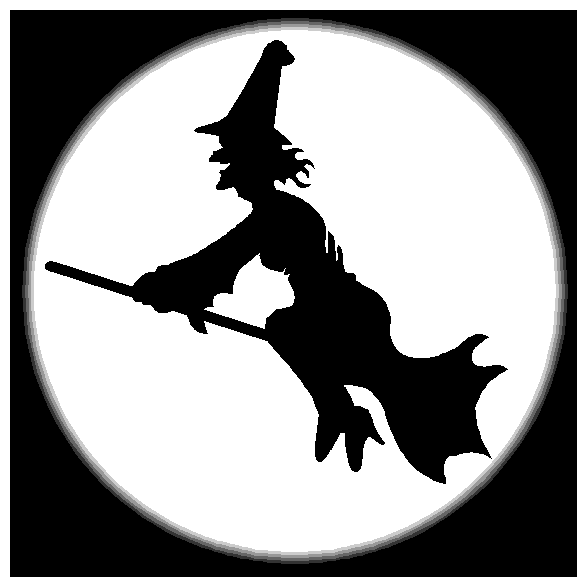
Your Homework is to compare this drawing's description with last class's and see how they are alike.
Thursday, November 6, 2008
Transfiguration: First Year: Week 3: Thursday
Professor Minerva McGonagall
Thursday
Gryffindor Time: 9:00
Ravenclaw Time: 10:00
Hufflepuff Time: 11:00
Slytherin Time: 10:00
First, we are going to continue the same spell as a few classes before. Yes, I do know that you are all tired of it, but you have to master it! Paper out and begin. I'll check your work in about, say, half an hour.
Wands down please. I would like all eyes on me. I believe that as a reward for all your hard work, you can all learn the counter charm to this spell. It will only work if your paper is fully wood-like. Without wands first repeat after me. Sillacharus. Louder! Sillacharus! Good. Wands out and toward your wood. I want you to try your hardest, of course, but I don't expect most of you to get it for a another few classes. You have fifteen minutes.
Fifteen minutes are up. Wands away please. Your homework is to take your wood with you and try to turn it into paper. Thats all. Class is dismissed until Tuesday.
Thursday
Gryffindor Time: 9:00
Ravenclaw Time: 10:00
Hufflepuff Time: 11:00
Slytherin Time: 10:00
First, we are going to continue the same spell as a few classes before. Yes, I do know that you are all tired of it, but you have to master it! Paper out and begin. I'll check your work in about, say, half an hour.
Wands down please. I would like all eyes on me. I believe that as a reward for all your hard work, you can all learn the counter charm to this spell. It will only work if your paper is fully wood-like. Without wands first repeat after me. Sillacharus. Louder! Sillacharus! Good. Wands out and toward your wood. I want you to try your hardest, of course, but I don't expect most of you to get it for a another few classes. You have fifteen minutes.
Fifteen minutes are up. Wands away please. Your homework is to take your wood with you and try to turn it into paper. Thats all. Class is dismissed until Tuesday.
First Year: Week 3: Thursday: Divination
Professor Sibyll Trelawny
Thursday
Gryffindor Time: 10:00
Ravenclaw Time: 2:00
Hufflepuff Time: 1:00
Slytherin Time: 2:00
Welcome back to Divination. Today we will Seeing once more with the aid of our circles. Please take out your pouch and key. Lay out a clean cloth onto the table and spread out your circles face down. I then want you to use them to answer the following questions with them.
What will tomorrow bring?
Will I start a new project?
End one?
What will the remainder of the week bring?
The month?
The year?
Then draw two rounds. Choose which one is for 'yes' and which is 'no'. Use them to answer five yes or no questions.
Class is over now. Please pack up your supplies and turn in your papers with your answers to me for grading. I'll see you next week.
Thursday
Gryffindor Time: 10:00
Ravenclaw Time: 2:00
Hufflepuff Time: 1:00
Slytherin Time: 2:00
Welcome back to Divination. Today we will Seeing once more with the aid of our circles. Please take out your pouch and key. Lay out a clean cloth onto the table and spread out your circles face down. I then want you to use them to answer the following questions with them.
What will tomorrow bring?
Will I start a new project?
End one?
What will the remainder of the week bring?
The month?
The year?
Then draw two rounds. Choose which one is for 'yes' and which is 'no'. Use them to answer five yes or no questions.
Class is over now. Please pack up your supplies and turn in your papers with your answers to me for grading. I'll see you next week.
Runes: First Year: Week 3: Thursday
Professor Babbling
Thursday
Gryffindor Time: 2:00
Ravenclaw Time: 9:00
Hufflepuff Time: 10:00
Slytherin Time: 11:00
Today we will be studying another rune that is most commonly called Dagaz. Here is the summory of Dagaz:
 Dagaz is also known as Daeg. If it is drawn in a runic reading, then generally the person is feeling the need to be invisble. If it is draw reverse, then the person is feeling the need to be less invisble. You can use this rune as a way to travel unnoticed. Oddly enough, this rune has the main meaning breakthrough.
Have you finished writing your notes? Well, then, here is the next one, Uruz.
 Uruz is also known as Ur. It stands for strength, determinations, perservance, courage, health, and assertivness. It is a rune that should be used in all healings. When drawn in a reading, the person who is being read for should be prepared for opportunity disguised as loss. If drawn in reverse, the person being read for should look deep with in themselves to see if they have been missing these opportunities in the set backs.
Once you finish on this one, I want you to get your notes on Mannaz as well. Pretend that you have drawn Mannaz, Dagaz, and Uruz for the past, present, and future. Write a report telling me how you would plan for the future and how you would interpret it.
It is ten minutes until your next class. Please put your quills away. If you have completed your report, please hand it up. If you haven't, finish it for homework. Off you go!
Thursday
Gryffindor Time: 2:00
Ravenclaw Time: 9:00
Hufflepuff Time: 10:00
Slytherin Time: 11:00
Today we will be studying another rune that is most commonly called Dagaz. Here is the summory of Dagaz:
 Dagaz is also known as Daeg. If it is drawn in a runic reading, then generally the person is feeling the need to be invisble. If it is draw reverse, then the person is feeling the need to be less invisble. You can use this rune as a way to travel unnoticed. Oddly enough, this rune has the main meaning breakthrough.
Have you finished writing your notes? Well, then, here is the next one, Uruz.
 Uruz is also known as Ur. It stands for strength, determinations, perservance, courage, health, and assertivness. It is a rune that should be used in all healings. When drawn in a reading, the person who is being read for should be prepared for opportunity disguised as loss. If drawn in reverse, the person being read for should look deep with in themselves to see if they have been missing these opportunities in the set backs.
Once you finish on this one, I want you to get your notes on Mannaz as well. Pretend that you have drawn Mannaz, Dagaz, and Uruz for the past, present, and future. Write a report telling me how you would plan for the future and how you would interpret it.
It is ten minutes until your next class. Please put your quills away. If you have completed your report, please hand it up. If you haven't, finish it for homework. Off you go!
Defense Against the Dark Arts: First Year: Week 3: Thursday
Professor Quirrell
Thursday
Gryffindor Time: 11:00
Ravenclaw Time: 1:00
Hufflepuff Time: 9:00
Slytherin Time: 1:00
Today we are going to continue our discussion on werewolves. We will be learning the distinguishing characteristics of the said beast. Please get out your quills and paper. The three main points to remember when distinguishing a werewolf from an ordinary wolf is to check three parts: the pupils of the eyes, the snout, and the tail. Highlight on your paper: Pupils, Snout, Eyes. Now for explanations of each.
If you ever have looked at a cat's eyes in bright light, you will see that the pupils are slits instead of rounds. If you look at a human's eyes at any light, the pupils will remain round. A werewolf always has slit pupils when in the transformed state, whether it is light or dark.
A wolf has a long, thin, pointed snout with a black nose. A werewolf, on the other hand, has a pigmentless nose with a long, thick pointed snout. The eyes are also slightly pigmentless and the eye rims are pure pink.
A wolf's tail is quite even all the way through, where as the werewolf has a remarkably thin tail that ends in a tuft not unlike a lions.
These are the characteristics that are the easiest to distinguish. There are body structrual traits as well, like bones that are in different places, but you must see the skeleton for that.
For homework, I would like you to research a picture of a wolf and draw your own. Then, from what I have just told you, create a drawing of a werewolf. That is due on Tuesday. Class is dismissed.
Thursday
Gryffindor Time: 11:00
Ravenclaw Time: 1:00
Hufflepuff Time: 9:00
Slytherin Time: 1:00
Today we are going to continue our discussion on werewolves. We will be learning the distinguishing characteristics of the said beast. Please get out your quills and paper. The three main points to remember when distinguishing a werewolf from an ordinary wolf is to check three parts: the pupils of the eyes, the snout, and the tail. Highlight on your paper: Pupils, Snout, Eyes. Now for explanations of each.
If you ever have looked at a cat's eyes in bright light, you will see that the pupils are slits instead of rounds. If you look at a human's eyes at any light, the pupils will remain round. A werewolf always has slit pupils when in the transformed state, whether it is light or dark.
A wolf has a long, thin, pointed snout with a black nose. A werewolf, on the other hand, has a pigmentless nose with a long, thick pointed snout. The eyes are also slightly pigmentless and the eye rims are pure pink.
A wolf's tail is quite even all the way through, where as the werewolf has a remarkably thin tail that ends in a tuft not unlike a lions.
These are the characteristics that are the easiest to distinguish. There are body structrual traits as well, like bones that are in different places, but you must see the skeleton for that.
For homework, I would like you to research a picture of a wolf and draw your own. Then, from what I have just told you, create a drawing of a werewolf. That is due on Tuesday. Class is dismissed.
Arithmancy: First Year: Week 3: Thursday
Professor Vector
Thursday
Gryffindor Time: 1:00
Ravenclaw Time: 11:00
Hufflepuff Time: 2:00
Slytherin Time: 9:00
Today I want you to take out your sheets that have things like animals and their corresponding numbers. Figure out today's number and then write down the corresponding food, animal, etc.
All set? You are now going to go on a treasure hunt. I want you to take your list of correspondances and hunt the castle up and down for them. Take note of things that you find and where you found them. With the food, bring a sample back. You have forty-five minutes. Off you go.
Did everyone find some of their things? Good. Please turn in your lists and your food. No homework. Time for your next class.
Thursday
Gryffindor Time: 1:00
Ravenclaw Time: 11:00
Hufflepuff Time: 2:00
Slytherin Time: 9:00
Today I want you to take out your sheets that have things like animals and their corresponding numbers. Figure out today's number and then write down the corresponding food, animal, etc.
All set? You are now going to go on a treasure hunt. I want you to take your list of correspondances and hunt the castle up and down for them. Take note of things that you find and where you found them. With the food, bring a sample back. You have forty-five minutes. Off you go.
Did everyone find some of their things? Good. Please turn in your lists and your food. No homework. Time for your next class.
Wednesday, November 5, 2008
Muggle Studies: First Year: Week 3: Wednesday
Professor Charity Burbage
Wednesday
Gryffindor Time: 10:00
Ravenclaw Time: 11:00
Hufflepuff Time: 9:00
Slytherin Time: 11:00
I thought that it was time for you to learn about the currency system that British Muggles use. They have eight coins and four banknotes. The coins are 1 penny, 2 pence, 5 pence, 10 pence, 20 pence, 50 pence, 1 pound, and 2 pounds and the notes are the 5 pound note, the 10 pound note, the 20 pound note and the 50 pound note. They use the decimal system meaning that there are one hundred pence to a pound.
To give you an idea on how much a pound is worth, consider this:
One galleon is worth £2.62
One sickle is worth £0.15
One knut is worth £0.005
This means that you need two knuts to get even one penny.
Now I want you to try to convert these problems. You may certainly use a calculator.
Pounds to galleons
£4
£8
£3.98
£1
£7.42
£2.11
I hope that you have figured all of these out. Next time maybe we'll try the reverse. For now, it is time to go. No homework, but please come dressed in Muggle clothing next class and come at 9 o'clock. I have a surprise for everyone!
Wednesday
Gryffindor Time: 10:00
Ravenclaw Time: 11:00
Hufflepuff Time: 9:00
Slytherin Time: 11:00
I thought that it was time for you to learn about the currency system that British Muggles use. They have eight coins and four banknotes. The coins are 1 penny, 2 pence, 5 pence, 10 pence, 20 pence, 50 pence, 1 pound, and 2 pounds and the notes are the 5 pound note, the 10 pound note, the 20 pound note and the 50 pound note. They use the decimal system meaning that there are one hundred pence to a pound.
To give you an idea on how much a pound is worth, consider this:
One galleon is worth £2.62
One sickle is worth £0.15
One knut is worth £0.005
This means that you need two knuts to get even one penny.
Now I want you to try to convert these problems. You may certainly use a calculator.
Pounds to galleons
£4
£8
£3.98
£1
£7.42
£2.11
I hope that you have figured all of these out. Next time maybe we'll try the reverse. For now, it is time to go. No homework, but please come dressed in Muggle clothing next class and come at 9 o'clock. I have a surprise for everyone!
Care of Magical Creatures: First Year: Week 3: Wednesday
Professor Kettleburn
Wednesday
Gryffindor Time: 11:00
Ravenclaw Time: 10:00
Hufflepuff Time: 10:00
Slytherin Time: 9:00
Today I want to explain to you the different sorts of diets of animals. Generally, you can sort animals into three catagories based on their diet: Herbavore, Carnivore, and Omnivore. A carnivore is an animal that eats only meat. An example of a carnivore is a griffin. A herbivore is an animal that eats only plants. An example of a herbivore is a unicorn. An omnivore is an animal that eats meat and plants. An example of an omnivore is a gnome because a gnome will eat both bugs and the roots of plants.
I want you to think back to October, when I had you make a chart that had you comparing the different traits of different creatures. Now, I want you to make that same chart, only comparing a herbavore, a carnivore, and a ominivore. You don't have to use my examples, you can find your own. I would recommend that you get out your copy of Fantastic Beasts and Where to Find them for this exersise. I think you have about forty-five minutes to complete this chart. I expect it done by the end of the class.
Forty-five minutes are up! I want all finished charts handed back in to me. If your chart isn't finished, then your homework is to finish it as well as write a report that defines the three catagories and give three examples of each. Class is dismissed.
Wednesday
Gryffindor Time: 11:00
Ravenclaw Time: 10:00
Hufflepuff Time: 10:00
Slytherin Time: 9:00
Today I want to explain to you the different sorts of diets of animals. Generally, you can sort animals into three catagories based on their diet: Herbavore, Carnivore, and Omnivore. A carnivore is an animal that eats only meat. An example of a carnivore is a griffin. A herbivore is an animal that eats only plants. An example of a herbivore is a unicorn. An omnivore is an animal that eats meat and plants. An example of an omnivore is a gnome because a gnome will eat both bugs and the roots of plants.
I want you to think back to October, when I had you make a chart that had you comparing the different traits of different creatures. Now, I want you to make that same chart, only comparing a herbavore, a carnivore, and a ominivore. You don't have to use my examples, you can find your own. I would recommend that you get out your copy of Fantastic Beasts and Where to Find them for this exersise. I think you have about forty-five minutes to complete this chart. I expect it done by the end of the class.
Forty-five minutes are up! I want all finished charts handed back in to me. If your chart isn't finished, then your homework is to finish it as well as write a report that defines the three catagories and give three examples of each. Class is dismissed.
Charms: First Year: Week 3: Wednesday
Professor Filius Flitwick
Wednesday
Gryffindor Time: 9:00
Ravenclaw Time: 9:00
Hufflepuff Time: 11:00
Slytherin Time: 10:00
Hello again class! Today we will be practicing what we have been learning in the past weeks because I have noticed that not all of you have mastered the spells and motions. So first, wands out! Now, I am going to come around to each table and have you demonstrate the motions. This one first! Let me see your swish. Good. Flick! Ok, now the point. Very good. I want you to practice those while I move on to the next tables.
Back to the first table! I want to see your levitation spells. I think that you have all mastered that one. Keep practicing though!
And back to you for the third and last time. This time I want to see you lumos and nox. Hmm... this one needs a bit of work. Try harder and practice all of the spells and motions.
Class time is up. Your homework is to practice even more! Class is dismissed.
Wednesday
Gryffindor Time: 9:00
Ravenclaw Time: 9:00
Hufflepuff Time: 11:00
Slytherin Time: 10:00
Hello again class! Today we will be practicing what we have been learning in the past weeks because I have noticed that not all of you have mastered the spells and motions. So first, wands out! Now, I am going to come around to each table and have you demonstrate the motions. This one first! Let me see your swish. Good. Flick! Ok, now the point. Very good. I want you to practice those while I move on to the next tables.
Back to the first table! I want to see your levitation spells. I think that you have all mastered that one. Keep practicing though!
And back to you for the third and last time. This time I want to see you lumos and nox. Hmm... this one needs a bit of work. Try harder and practice all of the spells and motions.
Class time is up. Your homework is to practice even more! Class is dismissed.
Astronomy: First Year: Week 3: Wednesday
Professor Sinistra
Wednesday
Gryffindor Time: Midnight
Ravenclaw Time: Midnight
Hufflepuff Time: Midnight
Slytherin Time: Midnight
Tonight we will begin by learning vocabulary. Please get out a quill and some parchment. I will want you to study these words for homework.
Ok, class. Time to come in. For homework, I want you to do several things. First, memorize what each of those words mean. Second, I want you to find out exactly how long a light year is and third, I want you to draw me a chart showing the zenith and the zodiac. That's all. You can go back to your nice warm beds now.
******* Thanks to Heartland for the definitions ********
Wednesday
Gryffindor Time: Midnight
Ravenclaw Time: Midnight
Hufflepuff Time: Midnight
Slytherin Time: Midnight
Tonight we will begin by learning vocabulary. Please get out a quill and some parchment. I will want you to study these words for homework.
Apparent magnitude. The brightness of an astronomical object, as observed on Earth and referred to the appearance of some objects chosen as standards. The scale of magnitudes is defined so that a difference of 5 magnitudes corresponds to a ratio of 100 in observed radiation intensity.
Azimuth. Angle measured clockwise around the horizon, from 0* towards the north, through 90* to the east, 180* to the south, 270* to the west, and to 360* due north.
Circumpolar stars. Stars that are close enough to the celestial pole that they do not rise and set each night but can be seen to move around the pole in a circular path. Latitude of observer determines which stars appear circumpolar.
Constellation. A group of stars that seemed to suggest the shape of some god, person, animal or object. Now a term used to designate a region of the sky. There are 88 constellations.
Declination. Angular distance of an object north or south of the celestial equator, measured in degrees. Thus the north celestial pole has a declination of +90 degrees.
Extragalactic. Beyond the Milky Way galaxy.
Latitude. Coordinate used to measure (in degrees) the angular distance of a point or celestial objects above or below an equator.
Light year. Distance that light travels in 1 year.
Longitude. Coordinate used to specify the position of a point or direction around (or parallel to) an equator.
Magnitude. Scale for describing brightness of a celestial object.
Meridian. Great circle, on the celestial sphere or the Earth, that passes through both north and south poles and an observer’s zenith or location.
Orbit. Path traced out by one object around another.
Rotation. Movement (spin) of a body abut an axis that passes through that body. Distinct from revolution, which is motion in an orbit about some point or other body.
Satellite. Body that revolves in orbit around another body. Planets are satellites of the Sun, the Moon is a satellite of the Earth, and artificial satellites have been sent into orbit around the Earth, Moon, Mars and Venus.
Sidereal. Related to the stars. Thus sidereal day, month, period, year: lengths of time intervals specified by motion of some object relative to the stars, as opposed to apparent lengths of those time intervals that will depend on the Earth’s own movements.
Zenith. Point on the sky directly overhead.
Zodiac. Band on the sky, centered on the ecliptic, and about 18 degrees wide, through which the Sun, Moon and planets appear to move through the course of each year.
Quills away now. I want you go outside and see if you can identify any stars. I'll call you back in when class is over.Ok, class. Time to come in. For homework, I want you to do several things. First, memorize what each of those words mean. Second, I want you to find out exactly how long a light year is and third, I want you to draw me a chart showing the zenith and the zodiac. That's all. You can go back to your nice warm beds now.
******* Thanks to Heartland for the definitions ********
Tuesday, November 4, 2008
Transfiguration: First Year: Week 3: Tuesday
Professor Minerva McGonagall
Tuesday
Gryffindor Time: 10:00
Ravenclaw Time: 9:00
Hufflepuff Time: 11:00
Slytherin Time: 9:00
We will be continuing the same spell as last time. Wands out, please. Paper is on your desk.
I am glad to see that you are making progress. Many of you have actual managed a nice grade of wood. Please hand all board up here and the paper, too.
Now, I want you to turn to your neighbor and discuss things that this spell is useful for. Find at least five uses. You have half an hour.
Time is up, class. What you have been discussing is now your homework. I want seven inches on two reasons this spell is useful. You may go now.
Tuesday
Gryffindor Time: 10:00
Ravenclaw Time: 9:00
Hufflepuff Time: 11:00
Slytherin Time: 9:00
We will be continuing the same spell as last time. Wands out, please. Paper is on your desk.
I am glad to see that you are making progress. Many of you have actual managed a nice grade of wood. Please hand all board up here and the paper, too.
Now, I want you to turn to your neighbor and discuss things that this spell is useful for. Find at least five uses. You have half an hour.
Time is up, class. What you have been discussing is now your homework. I want seven inches on two reasons this spell is useful. You may go now.
Divination: First Year: Week 3: Tuesday
Professor Sibyll Trelawny
Tuesday
Gryffindor Time: 2:00
Ravenclaw Time: 11:00
Hufflepuff Time: 2:00
Slytherin Time: 10:00
Next I am going to have you create your own divining set that will be easy to use. You will need 38 of the disks in this basket. Now please draw on each of these disks one of these symbols:
acorn - good health
anchor-voyage
arrow-bad news in a letter
balloon-troubles lifting
bat-disappointment
bee-meeting friends
bells-good news
birds-good luck
book-learning
cat-treachery
circle-love
coin-payment of debt
cross-trouble on the way
dog-faithful friends
egg-increase
fish-news from abroad
flag-danger
flowers-love
glove-luck and honour
hammer-triumph
hand-friendship
hat-new work
house-stability
key-unveiling of mystery
leaf-good luck
man-unexpected visitor
moon-love
needle-respect from others
owl-bad health
rabbit-success
shoe-career change
spider-money
star-good luck
sun-continued happiness
tree-success
triangle-unexpected event
umbrella-annoyences
wings-news
Also, please copy the list so that you have all of the meanings on hand.
Eyes up here, please. Now that you each have a set of these divining disks, I want you to practice using them. They are tokens that will tell you the future, if you can See. Spread them all face down on the table. As you swirl them around clockwise, think of a question. When you feel the time is right, pick one. It will tell you the outcome of the question. Try this for a few questions.
Time is up, now. Take one of these pouches and store your tokens in them. Your homework is to continue keeping a dream diary. We will be doing dream interpretation in the future...
Tuesday
Gryffindor Time: 2:00
Ravenclaw Time: 11:00
Hufflepuff Time: 2:00
Slytherin Time: 10:00
Next I am going to have you create your own divining set that will be easy to use. You will need 38 of the disks in this basket. Now please draw on each of these disks one of these symbols:
acorn - good health
anchor-voyage
arrow-bad news in a letter
balloon-troubles lifting
bat-disappointment
bee-meeting friends
bells-good news
birds-good luck
book-learning
cat-treachery
circle-love
coin-payment of debt
cross-trouble on the way
dog-faithful friends
egg-increase
fish-news from abroad
flag-danger
flowers-love
glove-luck and honour
hammer-triumph
hand-friendship
hat-new work
house-stability
key-unveiling of mystery
leaf-good luck
man-unexpected visitor
moon-love
needle-respect from others
owl-bad health
rabbit-success
shoe-career change
spider-money
star-good luck
sun-continued happiness
tree-success
triangle-unexpected event
umbrella-annoyences
wings-news
Also, please copy the list so that you have all of the meanings on hand.
Eyes up here, please. Now that you each have a set of these divining disks, I want you to practice using them. They are tokens that will tell you the future, if you can See. Spread them all face down on the table. As you swirl them around clockwise, think of a question. When you feel the time is right, pick one. It will tell you the outcome of the question. Try this for a few questions.
Time is up, now. Take one of these pouches and store your tokens in them. Your homework is to continue keeping a dream diary. We will be doing dream interpretation in the future...
Runes: First Year: Week 2: Tuesday
Professor Babbling
Tuesday
Gryffindor Time: 1:00
Ravenclaw Time: 2:00
Hufflepuff Time: 9:00
Slytherin Time: 2:00
Now that you have learned how to write in runic, I think that it is time for you to learn to what certain runes mean. Please take out a quill and copy down this sign:
Man or Mannaz
The Self
Modesty, Thought, Alturism, Trust
If someone draws this rune, it means that they need to know their self more. They need to stop and reflect. Also, it may mean that they need to trust more and be more modest.
I think that we will just start with one today so that I can explain it.
First, the names. One name is the Elder Futhark Name and the other is a newer name. On this one, Man is the Elder Futhark Name and Mannaz is the newer name. It is handy to know both names.
Second, this is the rune summed up into one or two words.
Next, I expanded on the main meaning.
Last, this is what I think it would mean if I drew this rune for someone. You'll learn how to do that later. It would mean the same thing if you drew the rune for yourself, but then you would know exactly where it applied to.
I want you to memorize this rune, because I will be giving you at least one more next class. Homework is to memorize Mannaz. Class is dismissed.
Tuesday
Gryffindor Time: 1:00
Ravenclaw Time: 2:00
Hufflepuff Time: 9:00
Slytherin Time: 2:00
Now that you have learned how to write in runic, I think that it is time for you to learn to what certain runes mean. Please take out a quill and copy down this sign:
Man or Mannaz
The Self
Modesty, Thought, Alturism, Trust
If someone draws this rune, it means that they need to know their self more. They need to stop and reflect. Also, it may mean that they need to trust more and be more modest.
I think that we will just start with one today so that I can explain it.
First, the names. One name is the Elder Futhark Name and the other is a newer name. On this one, Man is the Elder Futhark Name and Mannaz is the newer name. It is handy to know both names.
Second, this is the rune summed up into one or two words.
Next, I expanded on the main meaning.
Last, this is what I think it would mean if I drew this rune for someone. You'll learn how to do that later. It would mean the same thing if you drew the rune for yourself, but then you would know exactly where it applied to.
I want you to memorize this rune, because I will be giving you at least one more next class. Homework is to memorize Mannaz. Class is dismissed.
Subscribe to:
Posts (Atom)
